Travel eSIM is usually sold as a consumer story: holidays, digital nomads, “connect in two minutes.” Useful, for sure but that’s not the whole picture.
There’s a very real B2B use case for travel eSIM—especially for SMEs. Not the global enterprises with managed mobility platforms, negotiated roaming deals, and dedicated IT/security teams.
The most common scenario is much simpler:
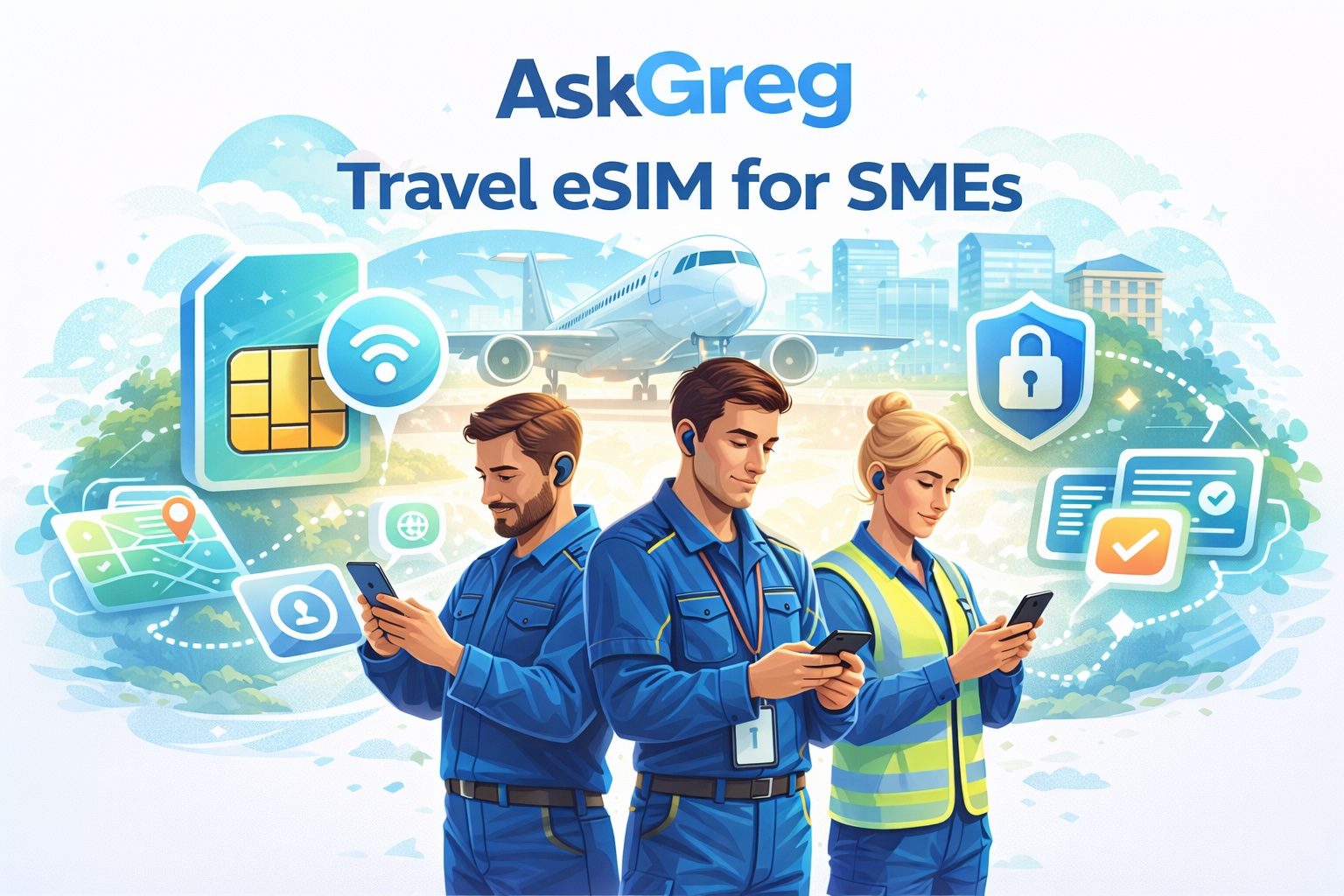
You are a mid-sized German company sending a technical team to Switzerland for one week to handle an installation or urgent maintenance. The team needs to connect immediately to internal tools (tickets, documentation, remote diagnostics), collaboration apps, and authentication from day one, not “once Wi-Fi works.” Travel eSIM closes that gap with predictable, company-controlled connectivity, while reducing dependency on insecure public networks.
The SME reality: travel happens, but mobility is rarely “managed”
Most SMEs don’t have a telecom manager. They don’t want a big project. And honestly, they shouldn’t need one just to keep people connected for business trips. So people improvise:
- mobile data stays off abroad to avoid bill shock,
- public Wi-Fi becomes the default (airports, cafés, hotel lobbies),
- someone ends up hunting for a SIM at the wrong moment,
- invoices and reimbursements become messy,
- and when something goes wrong, there’s no clear plan
A travel eSIM doesn’t magically solve everything, but it removes a lot of friction—with very little overhead.
Why it works in B2B ?
Think of travel eSIM as a lightweight mobility layer: quick to deploy, easy to standardise, and realistic for SMEs.
For the employee
- Connectivity on arrival: maps, messaging (including to the family), and the customer’s address work immediately.
- Less stress: no “I’ll connect later” moments when you’re in transit or on a job site.
- Predictable usage: a defined pack for a defined trip : simple!
- Better security by default: fewer reasons to jump on random Wi-Fi networks.
For the company
- Duty of care: the employee is reachable and can reach help—always. That’s not a nice-to-have; that’s responsibility.
- Lower cyber exposure: public Wi-Fi is convenient, but it’s also one of the easiest ways to create risk, especially for SMEs that don’t have layers of controls.
- Operational continuity: the team can access tickets, documentation, and remote tools without workarounds.
- Cost control: you choose the pack and the rules. No roaming roulette.
- Cleaner governance: fewer reimbursements, fewer exceptions, fewer “surprises” at month end.
The safety aspect (the part people underestimate)
If there’s one angle SMEs should take seriously, it’s this: travel connectivity is a safety tool.
Safety, here, has three faces:
- Personal safety: the employee can navigate, call, message, share location, and get assistance without hunting for a network.
- Business safety: headquarters can coordinate changes, delays, incidents, and last-minute customer requests in real time.
- Digital safety: fewer risky networks, fewer improvisations, fewer “quick fixes” that later become problems.
How to deploy it without over-engineering
Keep it simple:
- Define 3–4 trip profiles (EU short trip, non-EU short trip, multi-country week, frequent traveller).
- Assign a default pack per profile.
- Decide once who approves and who pays (many SMEs simply make it company-paid for business travel).
- Share a one-page checklist: when to activate, what to do if data is consumed, who to call.
Closing thought
SMEs just want a secure, predictable way to keep teams connected when they travel. Travel eSIM isn’t only about comfort. In an SME context, it’s often the simplest upgrade you can make to improve safety, continuity, and control—without turning it into a telecom project.
If you’d like to exchange views on these trends and what they could mean for your business, feel free to contact me.
Comments are closed