What alternative operators can do — and what the big ones rarely do
Across Europe, consumer protection obligations are multiplying. Tariff transparency, simplified cancellation, complaint handling deadlines, end-of-contract notifications — each new directive or national regulatory decision adds another line to the compliance checklist.
The typical reaction in most organisations: hand it to legal, implement the minimum required, move on.
That is a mistake. And for alternative operators, it is a missed opportunity — twice over.
What Regulators Mandated Without Realising It
Look at what the regulation actually requires.
In Belgium, the BIPT clarified in early 2026 the application of Articles 108, 109 and 110 of the Electronic Communications Code: operators must proactively recommend the most advantageous tariff to their customers, at least once a year, based on their actual consumption profile — including at contract renewals.
In other words: the regulator has made mandatory what a good retention programme should have been doing all along.
Analyse customer consumption. Identify the most suitable offer. Reach out at the right moment. Document the process.
That is exactly the sequence of a well-designed loyalty programme. Except most operators treat it as an administrative formality rather than a commercial touchpoint.
The Raw Material Everyone Is Sitting On
Here is where it gets interesting — and where I’ll be direct.
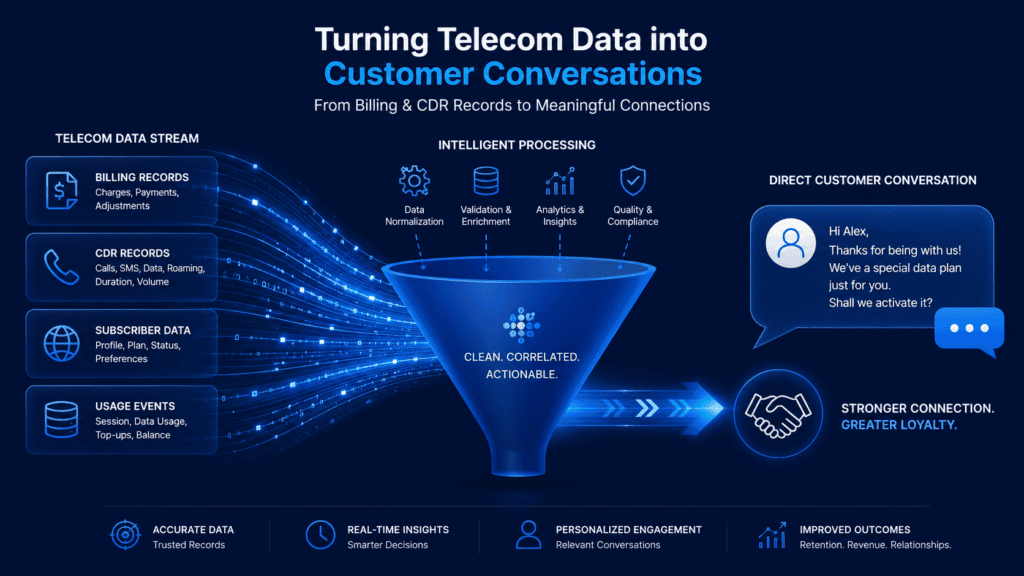
CDR data and billing records are, in my view, one of the most underexploited raw materials in telecoms. Operators generate this data continuously. It tells you exactly how a customer uses their service, when usage patterns shift, whether they are consistently over or under their plan, and when the conditions for churn — or upsell — are forming.
Most operators use this data for billing. Full stop.
The tariff transparency obligation essentially forces operators to do what they should have done with this data from day one: run a structured analysis, compare it against the available tariff portfolio, and act on the result.
The data is already there. The regulatory framework now requires you to use it. The only question is whether you use it minimally — to comply — or intelligently — to retain.
Every Obligation Is a Disguised Customer Moment
Tariff transparency is not the only example.
Simplified cancellation — a requirement in several European markets — is a moment of truth. Treat it as a form to fill in, and you lose the customer in silence. Treat it as a conversation opportunity, and you can recover a portion of churn with a relevant offer, at the right moment, without friction.
Complaint handling — imposed timelines, required traceability — is documented as one of the most powerful loyalty levers in the industry. A customer whose complaint is handled quickly and well is often more loyal than one who never had a problem at all.
End-of-contract communications — mandatory in many jurisdictions — are direct customer touchpoints, at the precise moment when the decision to stay or leave is being made. Few operators design them as anything other than a legal notification.
In every case, regulation has defined the moment. It has not defined what you do with it.
Why Large Operators Don’t Capitalise
The reason is structural. In large groups, compliance and customer retention operate in separate silos. Legal handles the obligations. Commercial handles retention. The two rarely connect.
The result: obligations are met, but the opportunity is left on the table.
Alternative operators — MVNOs, challenger fixed operators, VoIP providers — have a structural agility that incumbents do not. Fewer silos. Shorter decision cycles. And crucially, the ability to build a process end-to-end, without organisational legacy to work around.
But there is something else. A smaller operator can go further: by automating these regulatory touchpoints intelligently, they can establish a more direct, more personalised relationship with each customer than any large operator realistically can. Not a mass communication. A relevant, data-driven conversation — triggered by actual usage, at the right moment, through the right channel.
That is differentiation that does not require a bigger budget. It requires a smarter operating model.
What This Means in Practice
Turning a regulatory obligation into a retention lever is not a marketing project. It is an operational one.
It requires consolidated, actionable consumption data — starting with your CDRs. A structured and documented tariff comparison logic. Customer communication workflows triggered at the right moments. And a traceability layer that is audit-ready, but designed well enough to be commercially useful at the same time.
None of this is trivial. But operators who get it right earn two benefits for the price of one: compliance, and a retention programme their competitors have not built.
The Bottom Line
Consumer protection obligations are not a constraint to absorb. They are customer touchpoints that regulation has made mandatory — and that most operators still manage as paperwork.
For alternative operators, the window is clear: design these moments as retention processes, not compliance checkboxes. Use your billing data as the raw material it actually is. And build the kind of direct, personalised customer relationship that larger operators — by design — cannot easily replicate.
Customer retention is hidden in your regulatory obligations. You just have to decide to find it.
If you are working on structuring your consumer obligations — and want to turn them into an operational advantage rather than a compliance cost — I am available to discuss.
Sources & references
Comments are closed