
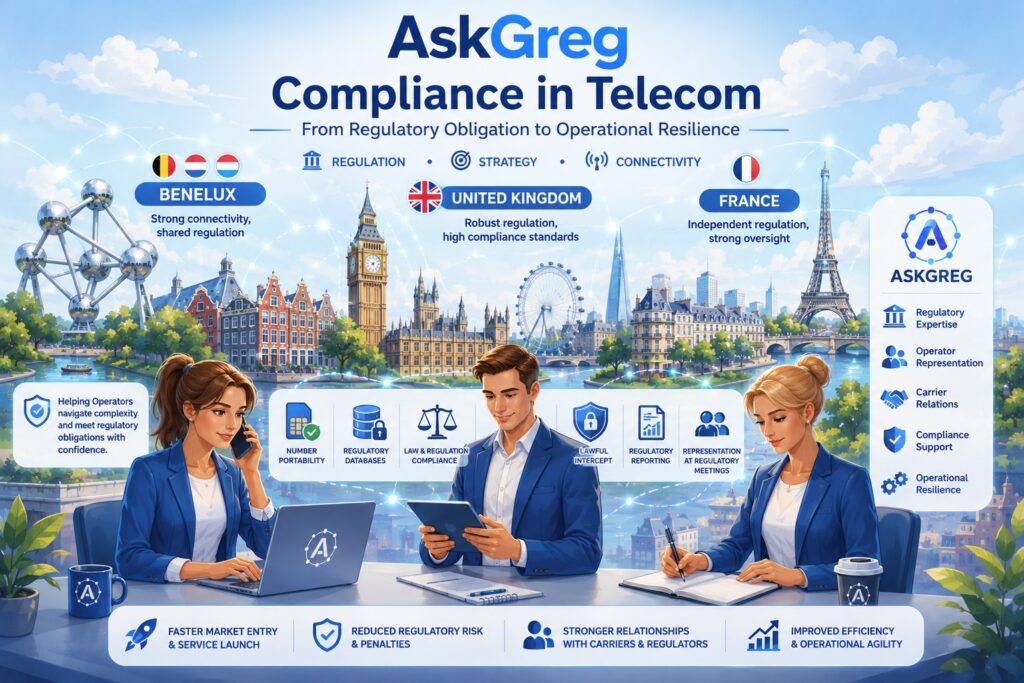
Telecom compliance is no longer confined to administrative reporting or legal documentation. Across Europe, regulators are stepping up enforcement and demanding that operators demonstrate operational readiness, responsiveness and governance.
Recent decisions by regulators in Belgium, Luxembourg and the UK confirm this trend: telecoms compliance is becoming a core operational discipline rather than a back-office exercise.
In Belgium, for example, the BIPT recently fined Colt Technology for failing to provide the requested information within the required timeframe under Belgian telecoms regulations. Similarly, the ILR issued fines in Luxembourg in 2025 against three operators for failing to provide the required regulatory information within the expected timeframes. Meanwhile, in the UK, Ofcom’s recent enforcement actions continue to demonstrate a broader regulatory shift towards stricter operational accountability. Whether relating to reporting obligations, operational resilience, customer protection, or market integrity, regulators are increasingly expecting operators to maintain robust governance frameworks and cooperate efficiently with the relevant authorities.
Compliance is becoming more complex
Compliance obligations continue to expand for telecom operators, especially MVNOs, VoIP providers, international carriers and new market entrants :
- Number portability processes and databases
- Lawful intercept readiness
- Data retention obligations
- Regulatory reporting
- Customer identification requirements
- Security obligations under NIS2 frameworks
- Coordination with public authorities and regulators
- Wholesale and interconnection obligations
- Operational documentation and audit readiness
Each requirement often involves multiple stakeholders, including regulators, incumbent operators, portability platforms, carriers, technical providers, legal teams and internal operations departments. Delays in one process, or an inability to provide accurate information within regulatory deadlines, can quickly lead to operational issues, delay market launches and expose operators to sanctions and reputational risks.
From Reactive Compliance to Strategic Compliance
A common pattern behind recent regulatory actions is the difference between reactive and proactive compliance. Operators that only address their obligations once issues arise often face higher operational pressure, greater remediation costs and unnecessary escalation with regulators. By contrast, operators that integrate compliance into their operational and go-to-market strategy are generally better positioned to:
- Accelerate market entry
- reduce regulatory friction
- improve operational coordination
- strengthen carrier and regulator relationships
- anticipate regulatory evolution
- Reduce pressure on management teams
Compliance is therefore evolving from a support function into a strategic operational capability
The value of fractional carrier relations and regulatory expertise
Many operators, particularly MVNOs, international groups and growing telecoms providers, do not require an entire internal regulatory department. However, they do require experienced guidance to bridge technical, operational, commercial and regulatory discussions. This is where a fractional carrier relations and regulatory advisory model can add real value.
At AskGreg, I support interconnection and carrier relations projects and help operators navigate increasingly complex compliance environments in a pragmatic and efficient manner. This includes:
- supporting interactions with regulators
- representing operators during meetings with authorities
- coordinating portability and operational obligations
- facilitating lawful intercept readiness discussions
- assisting with compliance processes and documentation.
- Bridging management, technical teams, carriers and regulators
The objective is simple: to transform compliance from a source of operational friction into a structured, manageable process that supports business continuity and growth.
In the telecoms industry, compliance is about more than just avoiding fines. It is increasingly about operational credibility, trust and the ability to operate efficiently within a highly interconnected ecosystem.
Comments are closed