
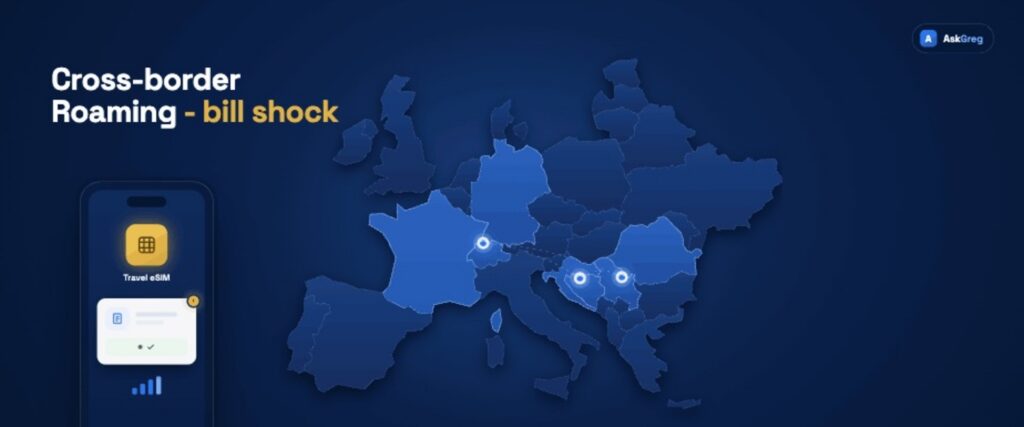
What ANCOM and IBPT’s roaming alerts reveal about the real market for travel connectivity
This summer, two regulators — Romania’s ANCOM and Belgium’s BIPT — published near-identical warnings about roaming charges outside the European Economic Area (EEA). Read separately, they look like routine consumer-protection notices. Read together, they say something more interesting about where the travel connectivity market is actually heading.
The problem regulators keep rediscovering
ANCOM’s numbers are worth sitting with: up to €2.62 per minute for calls and €4.76 per megabyte outside the EEA, with some operators billing a full data package the moment a single megabyte is used — even if usage stops seconds later. IBPT flags the same pattern from the Belgian side, naming the UK, Andorra, and Turkey as destinations where “Roam Like at Home” simply doesn’t apply. Neither regulator is describing an edge case. They’re describing what happens to an ordinary traveler on an ordinary summer trip.
RLAH progress hasn’t closed the gap
Roam Like at Home has genuinely worked inside the EEA, and its extension to Ukraine and Moldova on 1 January 2026 is a real step forward for Eastern European corridors. But the exclusion list hasn’t shrunk where it matters most for volume: the UK, Switzerland, Turkey, Bosnia, Albania… These aren’t fringe destinations — they’re some of the highest-traffic outbound routes for European travelers, which means the regulatory blind spot and the travel market overlap almost perfectly.
Why this matters beyond the occasional traveler ?
Travel eSIM marketing has largely targeted frequent flyers and digital nomads — people who already think about connectivity before they board. But the regulatory pattern here describes a much wider exposure: residents of border regions, once-a-year holidaymakers heading to Turkey or the UK, business travellers who’ve never touched an eSIM setting in their life. That’s not a niche. That’s most of the outbound European travel market, and it’s currently underserved by anyone selling connectivity as an afterthought.
What this means for operators and eSIM providers
From a go-to-market angle, the opportunity isn’t just reaching people who already know they need an eSIM. It’s building trust with a much larger segment that doesn’t yet default to eSIM as the obvious fix for a well-documented, regulator-confirmed pricing gap. Operators and MVNOs that still treat travel eSIM as commodity data will miss this. The ones building around clear pricing and honest fair-use terms — rather than the “unlimited, terms apply” model much of the category still leans on — have real room to build category leadership, not just market share.
Lessons for the industry
- Regulatory warnings are a signal, not a substitute for marketing — but they validate the problem at a market-wide scale.
- The addressable market for travel eSIM is wider than “frequent travelers”: border residents, once-a-year holidaymakers, and business travelers who never touch their own APN settings all sit inside it.
- Transparent pricing and fair-use policy are becoming real differentiators, not footnotes — especially as comparison content around “hidden roaming fees” gains search traction.
- The UK, Switzerland, Turkey, Monaco and the Balkan region remain the highest-risk zone for bill shock and, not coincidentally, the highest-opportunity zone for eSIM adoption.
I’ve spent the last few years helping operators and MVNOs think through go-to-market and carrier relations across Benelux and France. This is exactly the kind of regulatory signal that should shape a roadmap, not just a blog post — it tells you where the addressable market actually sits, not where the category has historically marketed itself.
If you’re building or refining a travel eSIM offer and want a second opinion on positioning or market entry, happy to compare notes.
Comments are closed